Most of the content teams currently panicking about Generative Engine Optimization (GEO) are burning through software budgets on metrics that mean absolutely nothing. They buy trackers blindly, drop hundreds of dollars on a dashboard subscription, and assume that seeing their brand name in a colorful graph means their search footprint is secure. If you are trying to figure out what is ziptie ai search analytics without reading another sponsored software brochure, you are probably realizing how little real information exists.
The industry is stuffed with lazy feature checklists that tell you what the tool looks like on paper. This article is about what happens when you try to scale it. It covers why your report generation stalls, how automated query discovery drops conversational data, and why the standard configuration ignores the exact surfaces your buyers use to make decisions. Let’s skip the marketing pitch and look at the real bottlenecks.
The Core Mechanics: What Is ZipTie AI Search Analytics Under the Hood?
Most traditional rank-tracking tools pull data through API approximations that completely miss how search results change across real user sessions. To understand what is ziptie ai search analytics from a technical standpoint, you have to look at its collection method: it uses live, browser-level monitoring. The platform loads a simulated user session, triggers a query, and captures the exact text string, citation links, and layout configurations that a human visitor encounters.
This live rendering approach explains why its initial accuracy scores look vastly superior to low-cost alternatives that rely on cached database calls. In direct benchmarks published by its creators, browser-level tracking captured AI Overviews on up to 28% of target keywords, while basic API-style tools dropped down as low as 1.6% on the identical keyword set.
"API rank tracking is dead for AI search; if your monitoring platform is not spinning up live browser sessions, you are looking at ghost data."
But running live browsers introduces an infrastructure bottleneck: rate limits, anti-bot checks, and queue delays. Search engines are actively deploying smart-blocking measures designed to slow down automated scraping. When you scale your tracking past a few hundred prompts, you will hit processing delays where reports sit in a queue for hours during peak platform usage. If your content team expects real-time validation for dynamic marketing campaigns, you are going to get bottlenecked by systemic queue delays and processing friction.
It was 7:45 AM on a Monday when my dashboard went completely dark. I had an 8:30 AM review with an enterprise tech client’s CMO to justify our organic search architecture budget. Instead of clean citation layout screenshots, I was looking at a frozen loading wheel and 400 queries stuck in an indeterminate processing queue. Google had quietly rolled out an infrastructure tweak to their anti-bot detection rules over the weekend, and ZipTie’s live browser runners were choking on the rate limits. I spent the next forty minutes drafting an emergency email to a highly skeptical executive, trying to explain why our real-time visibility tool was serving up yesterday’s ghost pages while engineering scrambling to update their proxy rotators.
The Engine Blindspot: Why Watching Three Platforms Leaves You Blind
The mistake intermediate SEOs make is assuming that tracking Google AI Overviews, ChatGPT, and Perplexity gives them a complete picture of their digital footprint. ZipTie monitors those three specific surfaces. It does not track Claude, Gemini, Copilot, Grok, or DeepSeek.
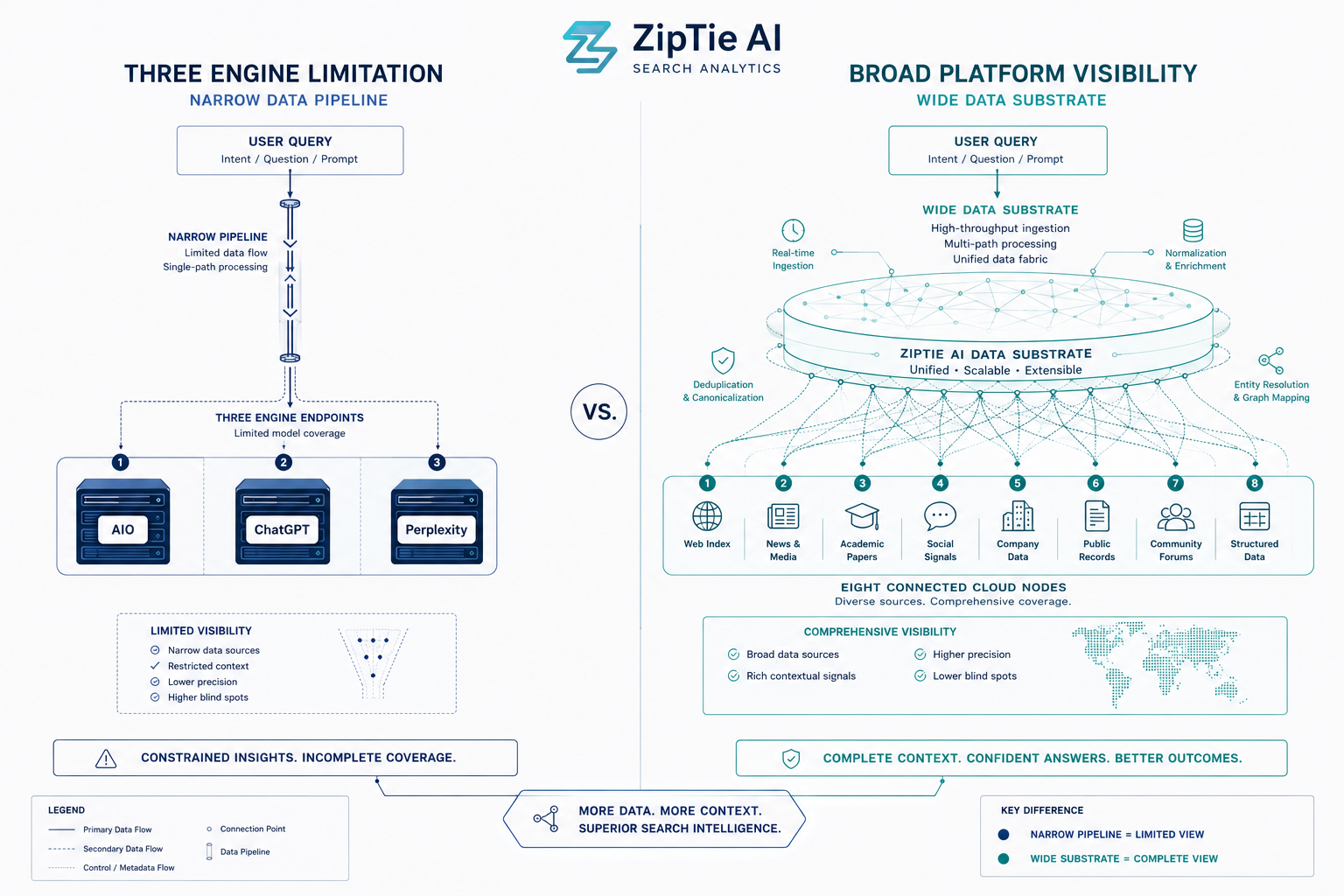
By isolating your tracking to a three-engine box, you miss a massive segment of your target intent profile. User workflows and technical research panels frequently distribute their search behaviors across multiple standalone models, using systems that integrated setups skip entirely. When you track only three platforms, you cannot compare how different models interpret your brand narrative. You will completely miss instances where one engine frames your product as an over-priced legacy system while another calls it a market leader.
The GSC Dependency: Why What Is ZipTie AI Search Analytics Misses Conversational Prompts
The onboarding flow for ZipTie relies heavily on an automated Google Search Console (GSC) integration. The pitch is simple: connect your account, and the tool automatically discovers which keywords trigger AI summaries. In practice, this dependency creates an immediate data blindspot.
GSC is designed around traditional keyword volume; it records impressions when a user types a clean, predictable phrase into a search bar. But AI search is intrinsically conversational. Users do not type "best project management tool" into an LLM; they paste a paragraph describing their broken internal workflow and ask for a line-by-line tool comparison.
Because these long-tail queries have near-zero historical search volume in traditional databases, GSC frequently misses conversational prompts entirely. If you rely on the hands-off import option, your tracking library will be stuffed with old-school keywords that do not reflect actual user behavior inside an AI platform. You end up doing manual prompt entry anyway, completely defeating the purpose of the automated setup.
What Happens After Setup: Why UI Shorthand Silently Reverts Your Context
To help prioritize optimization efforts, ZipTie condenses mention frequency, citation presence, and sentiment into a unified metric called the AI Success Score. It sounds clean on a weekly executive summary, but it forces dangerous assumptions onto your content strategy if you do not understand its underlying logic.
The scoring system weights a citation and a mention with generic values. If your brand is listed in a comparison table alongside four competitors, your visibility metrics tick upward. But if the accompanying text explicitly states that your software lacks enterprise security features, that generic metric bump is actively lying to you.
"An AI Success Score that treats a generic mention like a conversion-grade citation is just vanity metrics wearing a machine-learning badge."
If you do not map your tracking directly to actual landing page conversion records through your own analytics infrastructure, you will waste engineering sprints optimizing for prompts that drive zero business value. You need to see the actual session data arriving from specific referral paths to understand if an AI appearance is moving the needle.
The Scalability Wall: Credit-Based Billing vs. Real Workflow Automation
Let’s look at the actual costs of running these setups at scale, because this is where competing reviews copy the wrong data from outdated sources. ZipTie uses a credit-based pricing model with strict tier boundaries and single-seat limitations.
| Plan Tier | Monthly Base Price | AI Search Checks Count | Content Optimizations Limit | Included Seats |
|---|---|---|---|---|
| Basic | $69 | 500 | 10 | 1 |
| Standard | $99 | 1,000 | 100 | 1 |
| Pro | $159 | 2,000 | 200 | 1 |
The official pricing metrics show that the Basic tier sets you back $69 every single month for a limited pool of 500 AI search checks. If you want to scale up to 1,000 checks, you are forced onto the $99 Standard plan. For an agency tracking real enterprise search spaces across dozens of profiles, you are staring down a massive step up to custom enterprise tiers when you outgrow the 2,000 checks allotted on the $159 Pro plan.
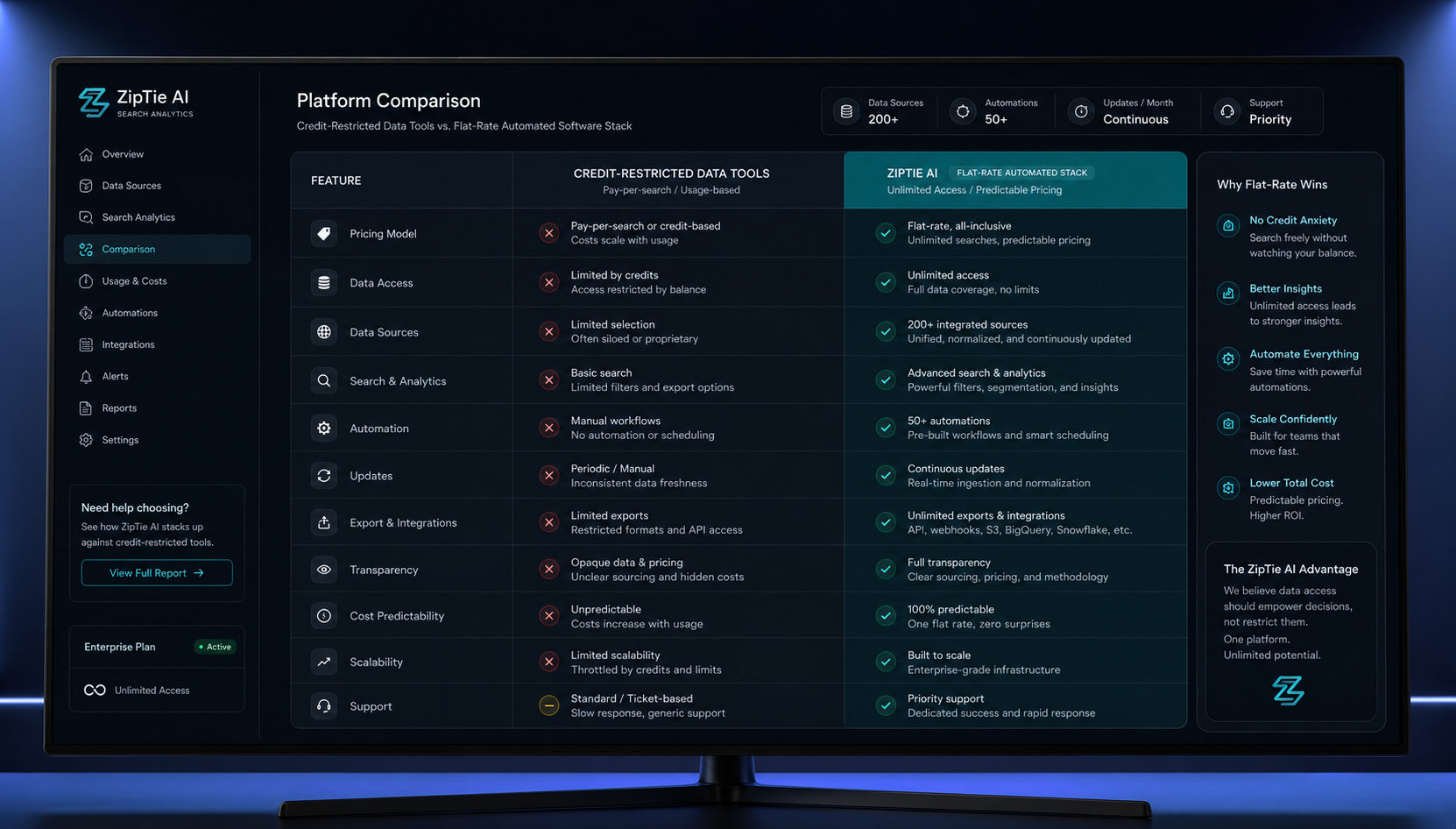
The problem is the architectural math. Each check covers all three platforms simultaneously. If you track a modest library of 200 conversational prompts across five clients every single week, your credit pool evaporates by day twenty. You are also hit with a single-seat restriction on these standard tiers, forcing your team to pass around passwords like college kids sharing a streaming account just to export a simple spreadsheet.
Stop staring at passive dashboard scores that tell you what happened three days ago. Audit your prompt ecosystem manually, identify where your high-intent traffic actually originates, and swap out generic keyword metrics for a customized data pipeline that connects directly to your internal database. Stop paying premium credit fees for isolated data silos. Build your own direct browser automation scripts, bypass the credit limits, and force your tracking metrics to match your actual pipeline conversions.
7. FAQ
Why is my AI tracking tool taking hours to update a single report?
Live browser monitoring takes time because it loads a real browser instance to pull actual data strings. When search engines change their rendering logic or trigger rate limits, automated queries get pushed into long processing queues until the infrastructure can process them safely.
Can ZipTie track my brand visibility inside Claude or Gemini?
No. The platform is built specifically to monitor Google AI Overviews, ChatGPT, and Perplexity. If your audience uses Claude, Gemini, Copilot, or Grok, you have to run your own manual validation scripts or look at a completely different platform stack.
Why did my automatic GSC import miss all the conversational queries?
Because GSC only records impressions for search terms that hit Google's traditional indexing systems. Long-tail prompts and paragraphs pasted into AI models do not mirror old keyword models, so the automated import skips them completely.
Is the AI Success Score reliable for planning a content roadmap?
No, it is a broad triage tool. It rolls up mentions and citation links into a single index, which means it can easily mask negative brand context or treat a low-value list mention like an actual high-converting pipeline citation.
What happens to my tracking credits if I don't use them?
Your tracking credit allocation resets completely at the end of every monthly billing cycle. Any unused checks are forfeited and do not roll over to the next month, meaning you pay for the entire block regardless of actual data usage.
Can I add my content team to a standard monthly plan?
No. The standard pricing tiers are explicitly restricted to a single user seat. If you need multi-user collaboration or separate agency profiles, you are forced to look at custom pricing layers or share single-user credentials within your internal group.